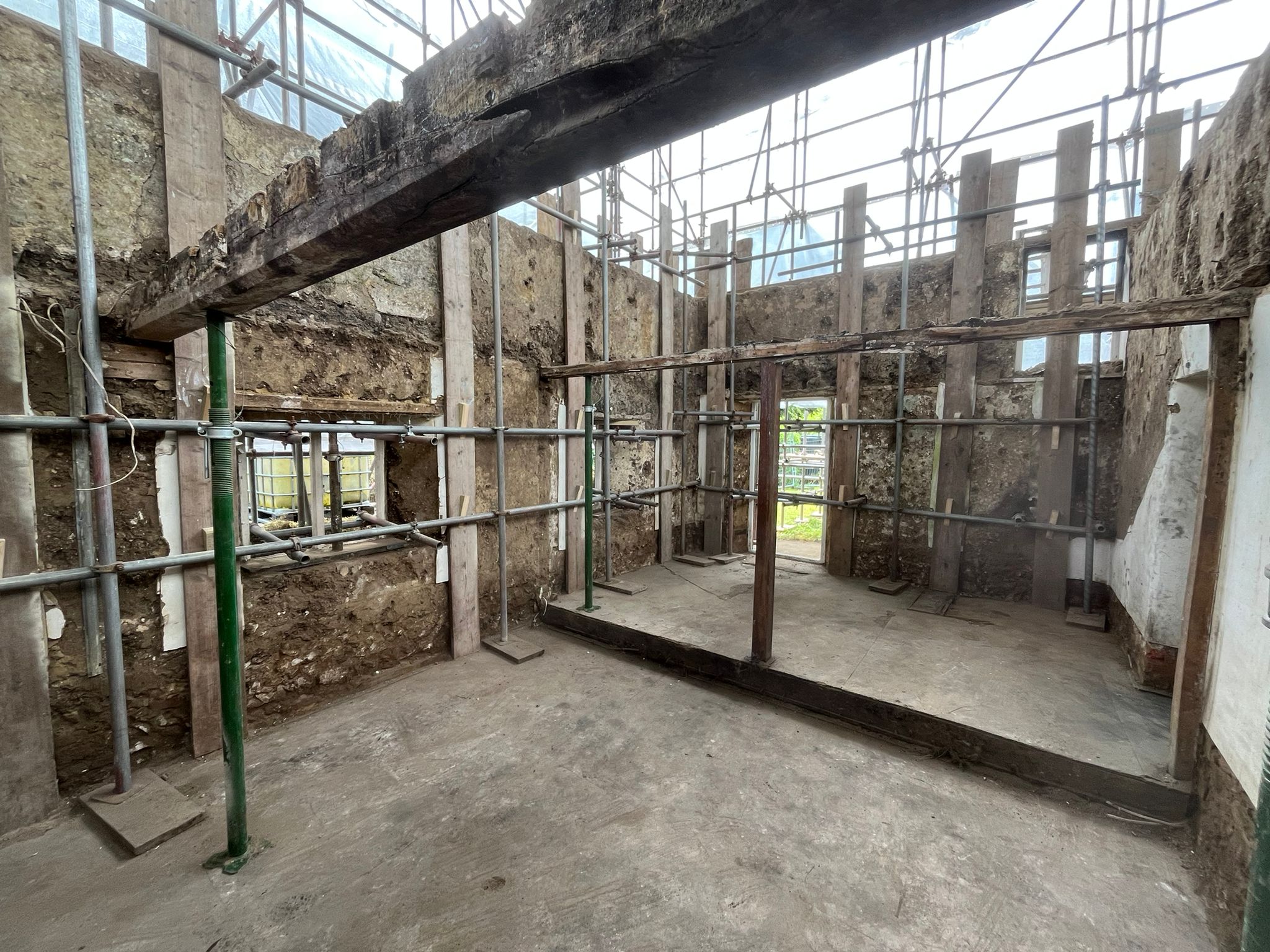
When we were first asked to get involved with this project, the cottage had already been through the worst. A devastating fire had destroyed the roof entirely, damaged the iron casement windows, and — perhaps less obviously — the water used to fight the fire had taken its own toll on the cob walls below.
For a while, demolition was on the table. The damage was extensive and the easy answer, on the face of it, was to start again. But working alongside our structural engineers (Mann Williams) and cob specialist (Brian Franklin & Son), we looked more carefully at what remained and concluded that the cottage was worth saving — that the walls, the beam, the bones of the building still had life in them. That conclusion changed everything.
Fire damage in a Grade II listed building is rarely straightforward. Thatch burns fast and hot, and the loss of a roof exposes everything beneath it in an instant. But it's often the secondary damage that presents the quieter, harder problems. Cob is a beautiful material — resilient, breathable, and deeply embedded in the building traditions of this part of Wiltshire — but it does not like to be wet. Saturated cob loses its strength and its character quickly, and without careful intervention it can deteriorate beyond saving.
The photograph above says a lot about where we are right now. The walls are propped, a temporary cover keeps the rain off, and the ancient oak beam — charred but still present — sits waiting. It looks precarious, but there is order in it. This is what enabling works looks like: unglamorous, methodical, and entirely necessary before anything else can happen.
The listed status adds another layer of responsibility to the work. Every decision — from how we dry out the walls to how the thatch is reinstated and the windows repaired — needs to be considered not just practically but in terms of what is appropriate for a building of this age and significance. In many ways though, that responsibility feels right. It keeps us honest.
There's something quietly moving about a project like this. The cottage sits on the edge of Salisbury Plain, in a landscape that doesn't change quickly, surrounded by buildings that have stood for centuries through harder things than this. Our job is to make sure this one gets to stand for a few centuries more.
We'll share more as the project develops.
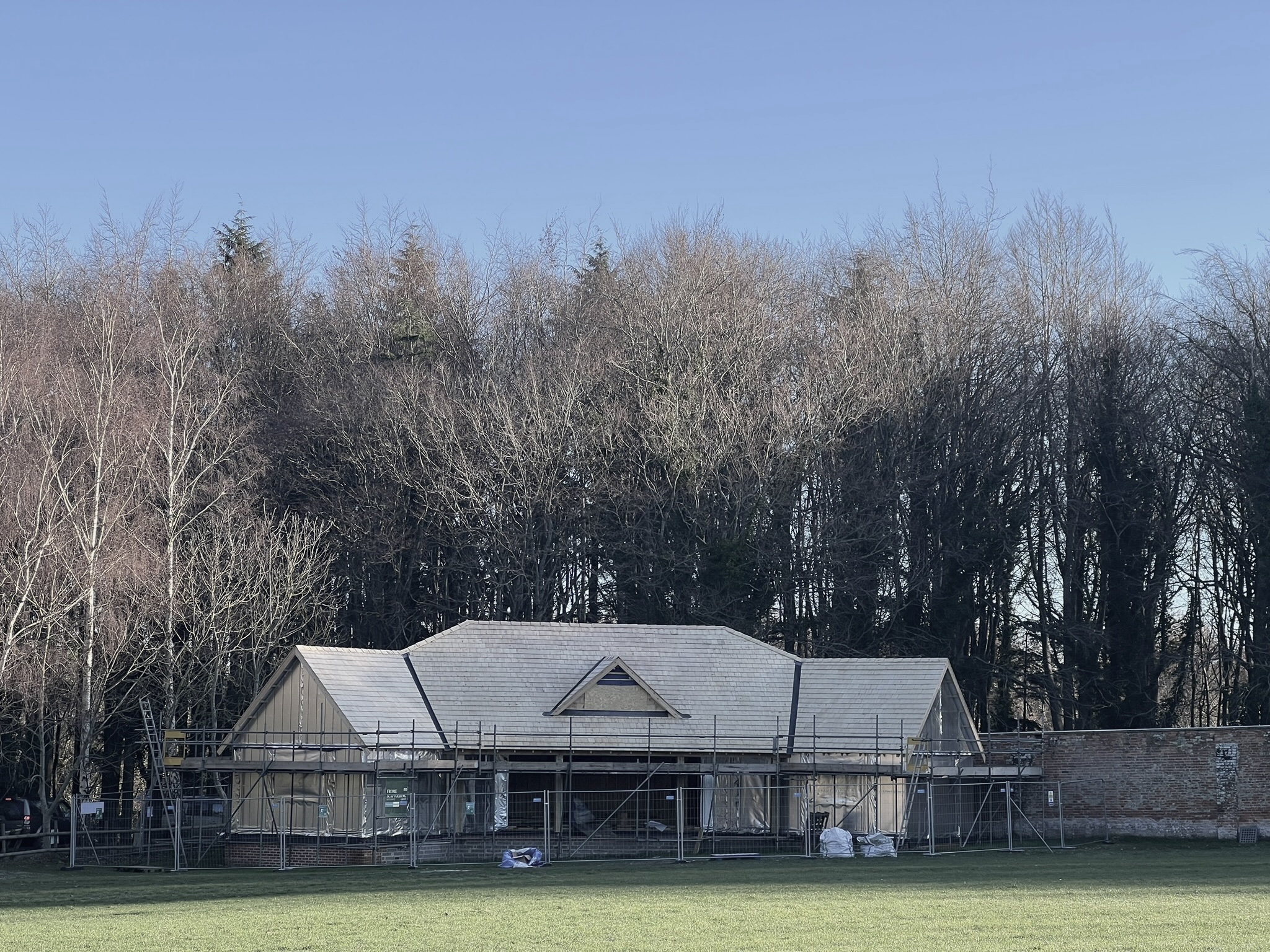
A new cricket pavilion is beginning to take shape at Erlestoke, thanks to an extraordinary community effort driven almost entirely by volunteers, donations, and goodwill.
The timber-clad pavilion, designed and project managed by Chalk, has already become a striking addition to the village cricket ground. Clad in cedar shingles and rooted in a traditional pavilion form, the building reflects both the rural setting and the club’s ambition to create a lasting home for local cricket and the wider community.
Construction work has relied heavily on volunteers, with members of the club giving up evenings and weekends to help move the project forward. From groundwork and carpentry to fundraising events and material donations, the pavilion has become a true community build.
Although the structure is now clearly visible, the project is not yet complete. Interior works and finishing details remain outstanding, and fundraising efforts are continuing to help bring the pavilion fully into use.
Club representatives say the response so far has been overwhelming, with support coming from local businesses, residents, tradespeople, and cricket supporters across the area. Once finished, the pavilion is expected to provide improved facilities for players, spectators, and junior cricket programmes for years to come.
The project stands as an example of what can be achieved when architecture, craftsmanship, and community spirit come together around a shared goal.
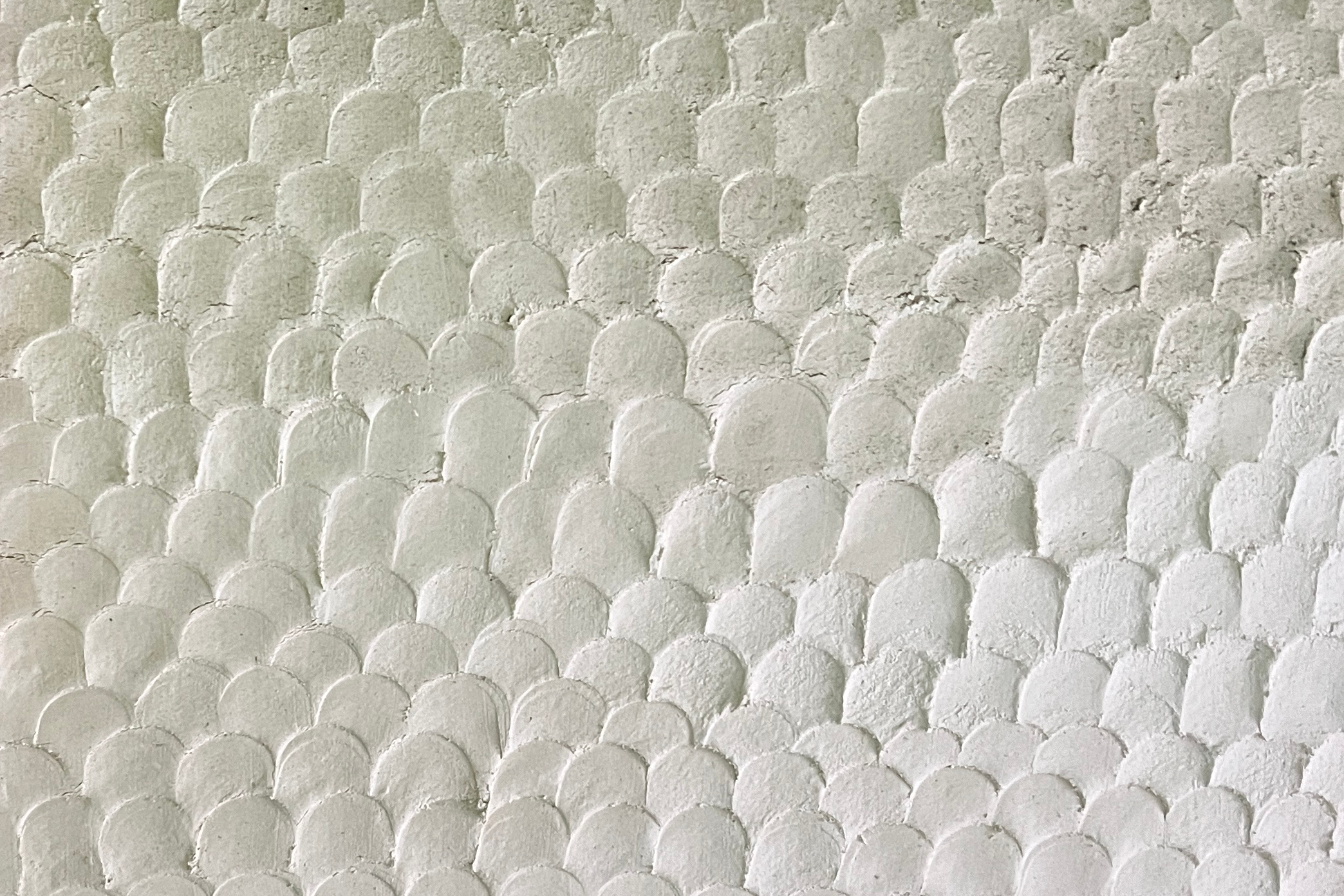
Until we started working on our own house back in 2020 my experience with lime was limited to a few isolated instances from my days up at the Centre of Alternative Technology. By the time we have finished the first phase of our house renovation (an architect’s house is never ‘finished’) it was clear that I needed a better grasp of this material if I was ever going to understand and work with older, traditional built buildings.
Lime was being used in some form since we (humans) started trying to shape raw materials into something more than the primitive hut. This material was key in understanding how our ancestors built and maintained their buildings. The buildings most people have now come to cherish.
Lime was used as a ‘glue’ to stick materials like stone and brick together and also as a coating to protect our homes and buildings form the weather. It could be used simply in a practical and rustic way but it could also be shaped and manipulated to form decoration and motif.
Its almost mythical status didn't stop there as whilst it was certainly an effective binder it also had a flexibility to it that allowed the less flexible materials it held together to move and settle without causing bigger structural issues.

After attending a recent RIBA South West symposium on Reimagining Resources: Buildings, Materials and Crafts, I was prompted to reflect on the role of craftsmanship in traditional buildings and how it contributes to the evolving character of a structure over time. The irregularity of craftsmanship creates character by introducing uniqueness, authenticity, and a human touch that machines or mass production can't replicate.
Integrating traditional crafts into our conservation work feels both intuitive and effective. These practices come with a rich history that we can honour and extend by continuing their legacy in a similar spirit. The real challenge, however, is finding ways to bring the same depth of character into our new-build work, especially when faced with the modern-day pressures of speed, budget constraints, and regulatory demands.
We must first ask… how can we define character in architecture?
A building with character tells a story. It speaks of its place - its topography, climate, and culture. It does not shout, but it resonates.
In practice, we see character manifest in subtle, often quiet ways such as a curved timber handrail worn smooth by generations or a window that frames an important view, possibly with a space to sit and have a quiet moment, or perhaps a threshold that marks not just transition in space, but in experience.
True character is never imposed. It grows out of an attentiveness to people and their rhythms. It reflects how they gather, retreat, connect, and reflect. Creating architecture that allows these moments is essential.

For many of our homeowner clients, securing planning permission is the most daunting part of their project especially when dealing with a listed building or in a heritage setting. The process can feel complex and unpredictably and I am not going to lie; it is.
At Chalk, we try to take the stress out of planning and de-risk the process. From early conversations with your local authority to managing the full submission, we try to make the process as smooth as possible. For example at Avonview House we engaged with the Conservation Officer very early in the process to discuss the bold design approach we might adopt to avoid a pastiche. This led to a relatively smooth process as we have the Conservation Officer's buy in from the very start.
While the UK planning system can seem like an obstacle, it’s designed to ensure projects are well considered and contribute positively to their setting. With clear advice and thoughtful design, gaining permission becomes less of a barrier — and more of an exciting step toward realising your project.
If you’re thinking about an extension, refurbishment, or new home and aren’t sure how to approach planning, we’d love to help. Our role is to guide you through each stage, so instead of worrying about policy and paperwork, you can focus on the excitement of creating your project.

Practical completion (contractual term for when the project is errr, practically complete) has been reach at Bolo’s Cottage; a lovely brick and oak addition to a modest thatch cottage in rural Wiltshire.
When our client came to us their brief was for a simple 'infill' kitchen extension. During the concept design stage we presented this simple idea to the client along with an alternative approach exploring the potential of their home and garden and providing more than our client thought was possible; they didn’t look back.I think this is our role as architects, to find, and reveal, the potential of the homes and buildings we work with. This is where we offer value beyond simply 'drawing' a client’s idea. Sometimes we go too far for sure (there was a third option for Bolos) but we need to do that to find the boundaries (physical, emotional and financial).
Anyway, great client, great builder and I think a successful project for all involved. May there be more. We just need to wait for the garden to rejuvenate itself after being abused for a few months and then we shall share some more photos.

A question we often get asked early in our residential projects. Unlike most significant investments we make in our lifetimes, the cost of a building project is difficult to define until the design is fully resolved. There are just too many unknowns. Imagine trying to figure out the cost of a car before it has even been designed! And unlike a car, every project is unique.
We work closely with our clients during the early stages of a project to make sure the project brief and client’s expectations align with the budget. We can then work together to adjust the brief accordingly or advise our clients they need to increase their budget. Often difficult conversations but the earlier they are had, the better for the project.
As a guide, the construction costs below are as based on recent projects and informal discussions with cost consultants and local builders. They are sense checked against published cost data and construction price indices.
Guideline costs per square metre..
New Build £2,500 to £4,500
Extensions £3,000 to £5,000
Renovations £1,500 to £3,000
They are given in good faith and as an indicative guide only i.e they intend to give an indication of what a building may cost. They do not provide a cost of what your actual project will cost.

In an age where superstition was a respected and integral part of daily life, carving an Apotropaic or ‘Witch’ marking into your house was an effective solution to the problem of evil incursions.
Without this symbolic protection, malign spirits might otherwise sneak into your home and wreak havoc. To 17th century Britain, nothing could be more terrifying. Save, perhaps, smallpox or the loss of a favourite ruff!
Once located and classified, these mysterious marks gift greater understanding of our beloved old buildings and those who lived within. However, they are easy to miss and are often mistaken for craftsmen’s marks or symptoms of wear and tear.

Each year we have decided to give away a percentage of our profits to charity. We are also not averse to doing pro-bono work for charity or organisations with an ethical approach (get in touch if you think we can help)
This year we are donating to the Dear Toby Trust…
“The Dear Toby Trust was established in 2017, in memory of Toby Hambrook-Skinner who passed away at Great Ormond Street Hospital after an epic battle with Acute Myeloid Leukaemia. He was just seven months old. Toby was diagnosed at eight weeks and began an aggressive treatment plan. Toby’s family and friends have set up this charity to find new ways to treat rare cancers and reduce the suffering of children enduring cancer treatment. Together we have raised more than £120,000 so far.
We believe there is a way to beat childhood cancer using less aggressive methods. The medical professionals need money to do this, money they don’t have.
Despite everything he faced Toby was a happy boy who made the most of every day and made those around him happier for knowing him. Now he is gone his legacy lives on – a more hopeful future for children with cancer.

These are our principles, what we stand for as a practice, how we gauge our success and the principles we are happy to be judged against.
1. Embrace Simplicity and the Ordinary
If it can it be built simply, with common materials in standard sizes, it should be.
2. Respect for the planet
Sustainability is not a choice, it is inherent in everything we design
3. Honesty in the use of Materials
If it looks like wood, it should be made of wood
4. Celebrate Craft
We aim to express how the building is put together in an honest way through the detail
5. Abhor the pastiche
A building or place should reflect its own era and not have a veneer of another
6. Create and sustain
Communities through building Not divide and diminish them
7. Encourage Cooperation, Collaboration and Learning
Understanding our weaknesses and learning from others’ strengths is vital to our development as a practice – “every day is a school day”
8. Design for People not Profit
We design buildings to bring joy and happiness to the people and communities who use them, not to make a profit to the people who build them.
9. Respond to Context
Our buildings should reflect people, location, scale, history, culture, landscape, community